
At high performing organizations the guiding compensation principle is the growth & profit responsibility. I have seen a very few companies where the company’s performance played a leading role in compensation.
While your senior team has the highest impact, it could not be done without the support of your junior staff.
Higher risk accountability => higher payoff
As you climb up the career ladder, your impact grows and thus your compensation should reflect bigger growth & profit responsibility. While junior staff starts with 10% variable pay, the top staff comes close to 50% variable pay. Sales teams have specific compensation guidelines aligned with sales quotas.
The full compensation package (base + var) should be benchmarked against market compensation and subject to your hiring strategy. For example: critical business roles are hired at 75 percentile of the market. Non-critical roles have total compensation at the market median.
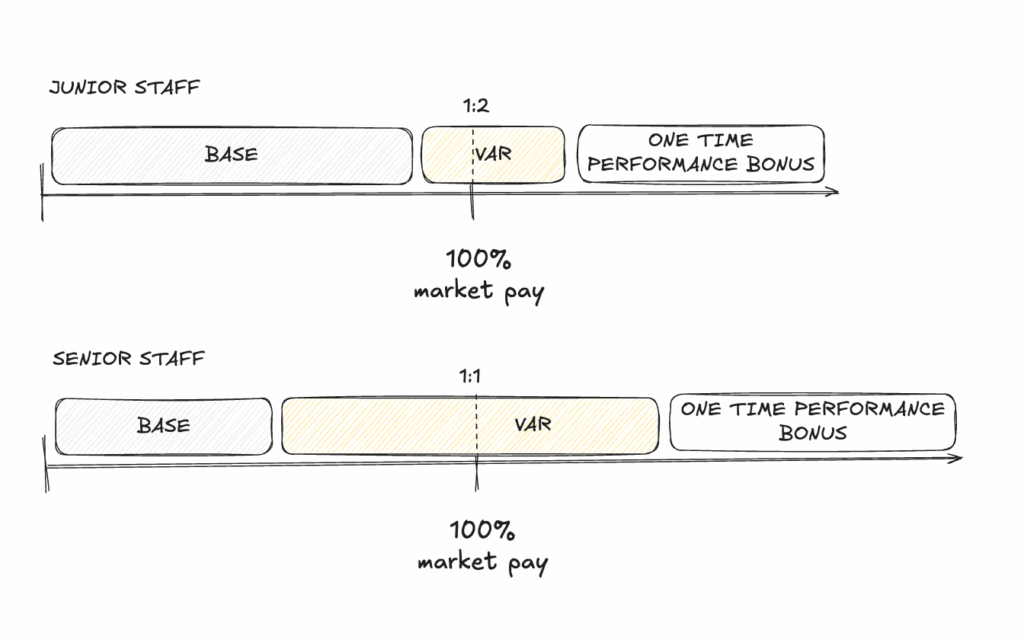
You need to stress test your compensation against business scenarios (base case, optimistic, pessimistic) to ensure that people are not constantly underpaid.
How to scale your compensation
Your compensation principles should stay with growing organization. Pay grades are core pillars to your compensation system. Learn more about career ladder and pay grades.
For the variable pay, you can target different company performance metrics – growth or profit (gross / operating / net). Check out this profit sharing structure.
Lastly, if you are considering equity participation, consider these options for equity compensation.
OKR and bonus?
This is highly disputed topic. The biggest risk here is that people will blindly follow OKR to get their bonus. If OKRs are set incorrectly than your company suffers. Thus I suggest to start practicing OKR without bonus. Once you are comfortable with setting OKRs (i.e. you are good in estimating 80% attainment rate), you can cap individual or company variable pay to 80%, if OKRs are fullfiled at <60% rate.