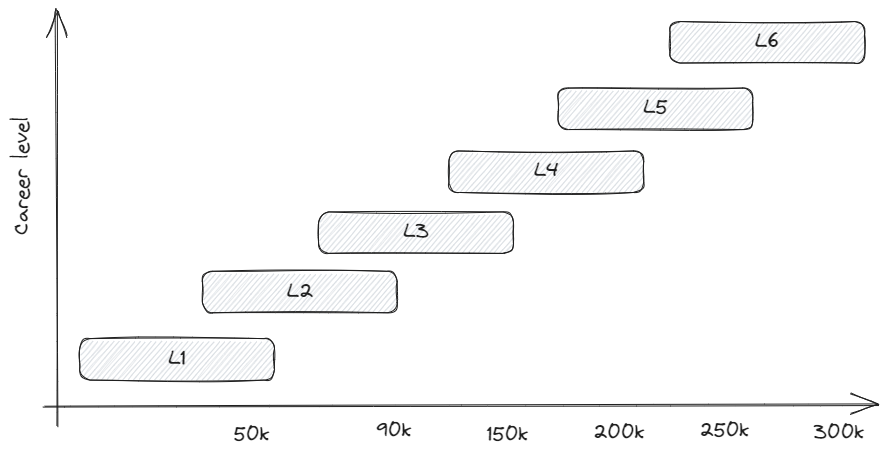
- Pay grade is a compensation range that is assigned to a specific job and seniority.
- Pay grades are also associated with a career ladder (see end of this article).
- Career ladder is a summary of all jobs by seniority defined by required competencies.
Competency = know-how + skills + behavior
A career ladder serves as a guideline for employee’s career path in the company. It usually represents a collection of hard and soft skill requirements for a specific role in the company. Let’s take an engineer who starts as a junior and his problem solving skills, communication needs, and overall impact reflect the beginners level. As the engineer makes progress, their competencies mature and this is reflected in the career ladder in form of expectations.
In many organizations, especially larger ones, career ladders are formalized with specific job titles, responsibilities, and requirements associated with each level. Advancement typically involves increased responsibilities, higher-level tasks, and often, higher compensation.
Understanding the career ladder in your chosen field can help you set goals, plan your professional development, and make informed decisions about your career path.
How to build a career ladder
Write down all current roles and seniorities in your company. Limit the number of seniorities to 5-7. Determine competencies for each role and seniority. This will require some time. Faking it now will create management debt, that will materialize when hiring, promoting, and adjusting salaries. Once finished, assign each employee to a particular role and seniority.
| SALES | ENGINEERING* | |
| L6 | VP Sales | CTO |
| L5 | SDR (BDR) Manager | Eng. manager |
| L4 | Senior Account Executive, Enterprise SDR (BDR) | Senior engineer |
| L3 | Account Executive, Senior SDR (BDR), Account manager | Engineer |
| L2 | Sales Representative | Junior Engineer |
| L1 | Trainee | Trainee |
* It is common practice to introduce a separate career ladder for team leaders and individual contributors.
Next, validate roles & seniorities with a scoring model. The scoring model also provides solid guidence when promoting people to higher levels, You might also find out, that some people are not as senior as you think.
Scoring model example:
| 1 point | 2 point | 3 points | 4 points | |
| Education (weight 1.0) | high school | Bachelor | Master | Advanced degrees |
| Experience (weight 2.0) | 0-2 yrs | 3-5yrs | 6-8yrs | 9-12yrs |
| Time horizon of the longest task (weight 1.0) | daily to weekly | weekly to monthly | quarterly to annualy | longer than 1 year |
| Scope of work (weight 1.0) | executional: carries out concrete tasks | operational: follows a process or methodology | tactical: determines the best way to meet goals | strategic: establishes plans, objectives, policies |
| Leadership criteria: type of objectives | delivering piece of work | significant parts of larger project | annual goals and projects with business impact | long term viability of the firm |
The final step is to assing market compensation to each career level. The best practice is to keep the compensation range at +/-20% per level. Also, compensation at each level will overlap by <20%. The range and overlaps enable to recognize high/low performers and individual progress in competencies at each level.